
Painting Legacy Into the Walls: How Two Portrait Commissions Changed Me as an Artist
By Sarina Freincle | A Beautiful Distraction | Fine Art | Lowcountry, South Carolina
Some paintings you make. Others make you.
Over the past year, I completed two of the most meaningful portrait commissions of my career — and neither of them started with a client brief or a price per square foot. They started with names. Names that belong to real people, real communities, real history — history that is still breathing right here in the South Carolina Lowcountry.
This is the story of those two projects: The Johns Island Elementary School lobby mural alone spans 384 square feet, 27 feet wide, 14 feet tall a wall-sized declaration of who Johns Island is and where it comes from. a series full mural and six oval oil portraits of Johns Island civil rights figures now living in a school setting for every child who walks through those doors to see. A single oil portrait of Wilmot J. Fraser Sr., permanently installed at the school that bears his name, The Early College High School on the Wilmot J. Fraser campus, and
I'm sharing this because these commissions weren't just art. They were acts of remembrance. And I think you should know how they happened.
The Fraser Portrait: One Man, One School, One Painting That Will Outlast Us All
When I was commissioned to paint Wilmot J. Fraser Sr., I understood the weight immediately.
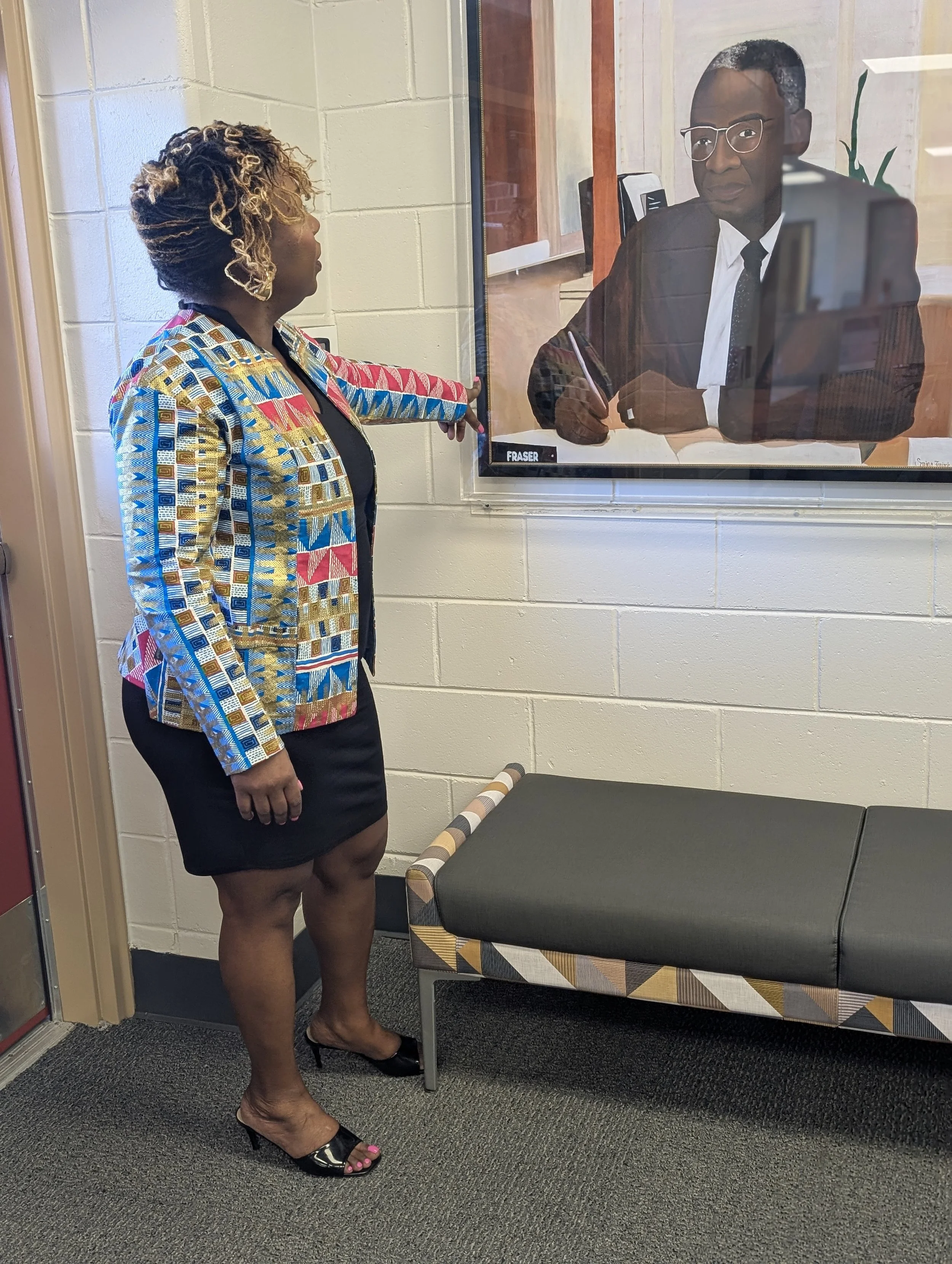
This wasn't a portrait to hang in a living room. It was a portrait to hang in a school — his school. A building named after a man, filled with children who would grow up beneath his gaze without necessarily knowing who he was. My job was to make sure that face told a story before anyone spoke a word.
I work in Winsor & Newton oil paints, and for portraits of this significance, I don't rush the skin tones. Every layer is intentional. Warm light planes built up with Yellow Ochre, mid-tones anchored in Raw Sienna, and deep shadows mixed chromatically using Burnt Sienna and French Ultramarine rather than reaching for a tube of black. The goal is always the same: a face that looks alive, not archived.
What strikes me most about this kind of commission is the permanence. A painting in a school doesn't retire. It doesn't get packed away in a garage. Generation after generation of students, teachers, parents, and administrators will pass that portrait. Some will stop and look. Some won't. But it will be there, holding space for a legacy that deserved to be held.
That's the responsibility I carry into every brushstroke when the subject is real, historical, and irreplaceable.
The Mural: 384 Square Feet of Johns Island History
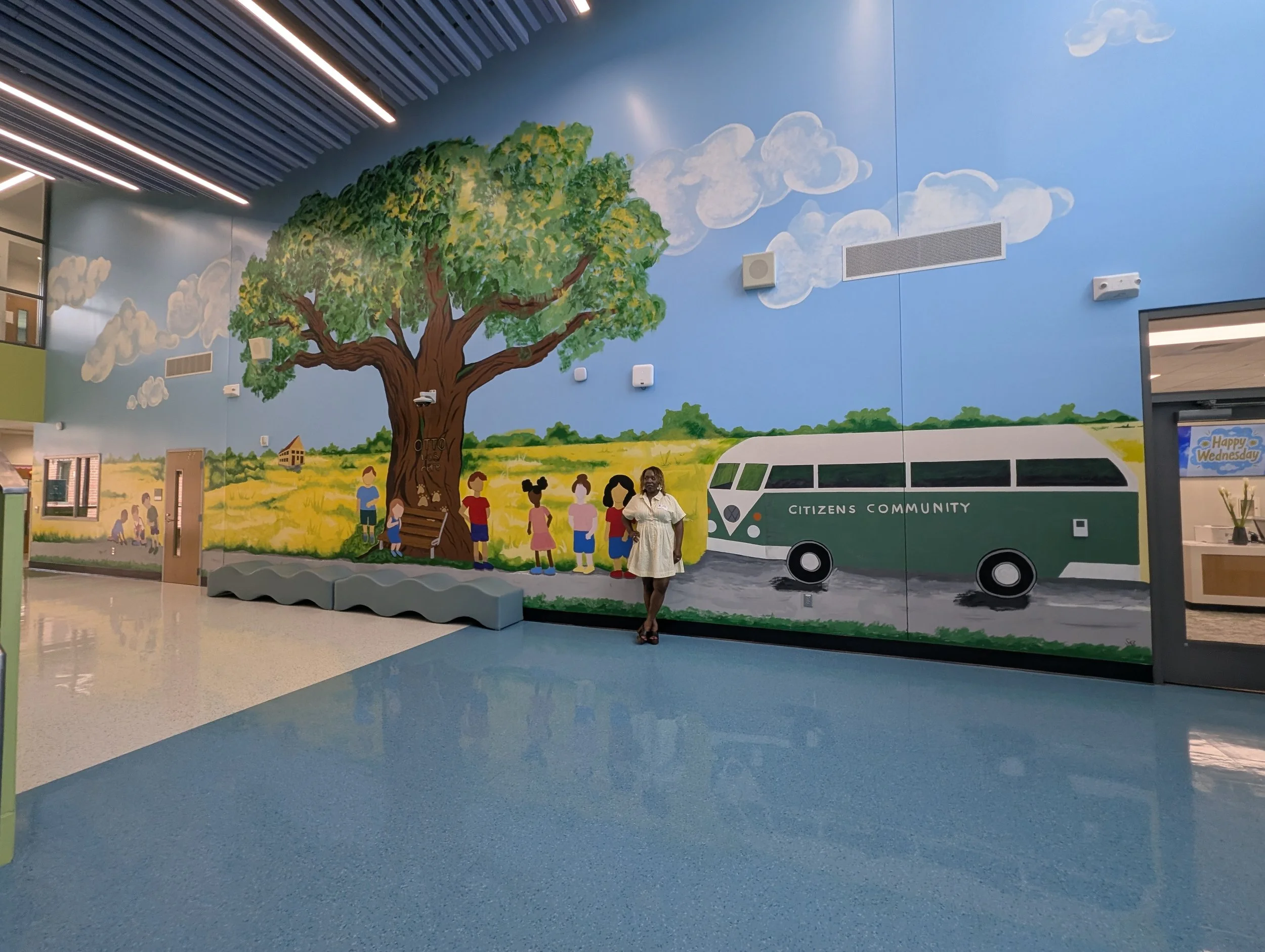
That's me standing in front of it. And I need you to really look at that wall.
27 feet wide. 14 feet tall. 384 square feet — painted across the entire west lobby wall of the new D9 Elementary School on Johns Island, Charleston County School District.
Every child who walks through those doors every single morning is going to see this. That is not something I take lightly.
The mural centers on a large live oak tree because if you know anything about Johns Island, you know the trees are witnesses. The Angel Oak has stood there for over 400 years. These trees have seen everything. The tree in this mural is rooted, expansive, and alive, and underneath it, a group of children stand together in a golden field. They have no faces. That was intentional. Those children are every child. No one is excluded. No one is erased. Every student who looks at that mural can see themselves in it.
To the right of the tree stands a vintage green bus painted with the words CITIZENS COMMUNITY — a direct reference to the Citizens' Committee, the grassroots organization that Esau Jenkins and others used to mobilize Black voters on Johns Island in the 1950s and 60s. Esau Jenkins literally drove a bus. He used the ride from Johns Island into Charleston to teach his passengers how to read so they could pass the literacy tests required to vote. That bus wasn't just transportation. It was a freedom school on wheels.
It's on the wall now. In a school. Where children will grow up knowing it existed.
Behind the tree, a small historic church anchors the left side of the composition — a nod to the role the church played as the center of community life and civil rights organizing throughout the Sea Islands. A bench sits beneath the tree. The grass is golden and full. The sky is open and blue.
This mural is sealed, permanent, and installed. It is not going anywhere.
The Portrait Series: Six Faces. One Shared Struggle.
The mural tells the story of a movement through landscape and symbol. The portrait series tells it through faces.
Six oval oil paintings. Six figures whose lives shaped the Lowcountry in ways that most people — inside South Carolina and out — have never been formally taught:
Esau Jenkins — educator, bus driver, and civil rights leader who launched the Citizenship Schools movement that spread across the entire South, teaching Black adults to read so they could register to vote. He is the heartbeat of this series.
Janie Jenkins — his partner in both life and mission. Her contributions are often eclipsed by his name in the history books. They are not eclipsed here.
William "Bill" Saunders — community organizer and radio broadcaster whose voice literally carried the movement across the airwaves of the Lowcountry.
Hermina B. Traeye — an educator whose quiet, relentless dedication to her community defined what servant leadership looks like when no one is taking your photo.
John Washington — a community pillar whose work on Johns Island kept the movement rooted in the soil of the Sea Islands.
Mattie Washington — whose story, like so many women in the civil rights era, deserves to be told louder and longer than it has been.
Six people. Six paintings. All of them oval — a deliberate choice that is worth explaining.
The oval portrait format has historically been reserved for presidents, generals, and founding fathers. It signals: this person mattered. It places these figures in the visual tradition of formal portraiture — the kind of portraiture that has not always been extended to Black Southerners, to Sea Island residents, to the people who organized in churches and on buses instead of in government buildings.
That is not an accident. That is the point.
I painted each portrait in Winsor & Newton oil paints, using the same chromatic discipline I bring to every serious portrait commission — no tube black, no shortcuts. Shadows are built from Burnt Sienna and French Ultramarine, mixed to a deep, living dark that has temperature and presence. Skin tones are layered — warm light planes in Yellow Ochre, mid-tones in Raw Sienna, shadows that recede without going dead. These people were not flat. Their lives were layered, textured, warm, and complex. The paintings had to be too.
The series was delivered on deadline and is now permanently installed in a school setting where students see these faces every day.
What These Two Projects Mean Together
The mural and the portrait series were separate commissions. But standing back and looking at them together, they tell one story.
The mural says: this community organized, gathered, rode together, and rooted itself in this land.
The portraits say: and these are the faces of the people who made that possible.
One speaks in landscape and symbol. The other speaks in portraiture and presence. Together they form something I didn't fully understand until both were finished a complete act of witness.
I am a Black woman from New York, planted in South Carolina. I have made the Lowcountry my home, my community, and my creative ground. I ran for city council as the first Black woman to do so in Goose Creek. I show up. But this work the mural, the portraits, the hours inside a school lobby making sure the tree looks like it has roots, this is the most honest expression of what I believe art is actually for.
Art is not decoration. It is documentation. It is declaration. It tells the next generation: these people were here. They mattered. You come from something real.
What a Legacy Portrait Commission Looks Like (If You're Wondering)
I receive commissions for institutional portraits, community honorees, family legacies, and historical figures throughout the South Carolina Lowcountry and beyond.
Every commission begins with a conversation — about who the subject was, what they meant to the people who loved them or the community they served, and what the painting needs to do in the space where it will live.
From there, I work in oil on panel or canvas, using a chromatic painting process that prioritizes life, warmth, and accuracy over formula. Timelines vary by scope, but I treat every portrait as though it will be the most permanent thing I ever make — because it might be.
Let's Keep This Story Moving
If you're a school, institution, community organization, family, or city looking to commission a portrait that honors someone whose face and story deserve to endure — I want to hear from you.
And if this post moved you, if these names moved you, I hope you'll share it. The Lowcountry has more history than most people know. Part of my mission as an artist is to make sure that changes.
Commission inquiries: abeautifuldistraction.art
Follow the journey:
Instagram: @abeautifuldistraction
Facebook: A Beautiful Distraction
TikTok: @abeautifuldistraction
Sarina Freincle is a fine artist, muralist, and entrepreneur based in Goose Creek, South Carolina. Her work focuses on legacy portraiture, community murals, and original oil paintings that honor the people and places of the Lowcountry.
